
Okay, so let’s do a science experiment quickly. Clear your entire work calendar for one week from Monday to Friday, 9:00 AM to 5:00 PM.
Did you just have a feeling of panic rise up in your body? Did you immediately think, “No way, I have too many problems to solve and issues to fix to clear an entire week of my calendar”?
What if I told you that there was a methodology of solution-focused thinking that would help you solve all of those problems and even be able to avoid future failures? That’s where Design Sprints come in.
What are Design Sprints?
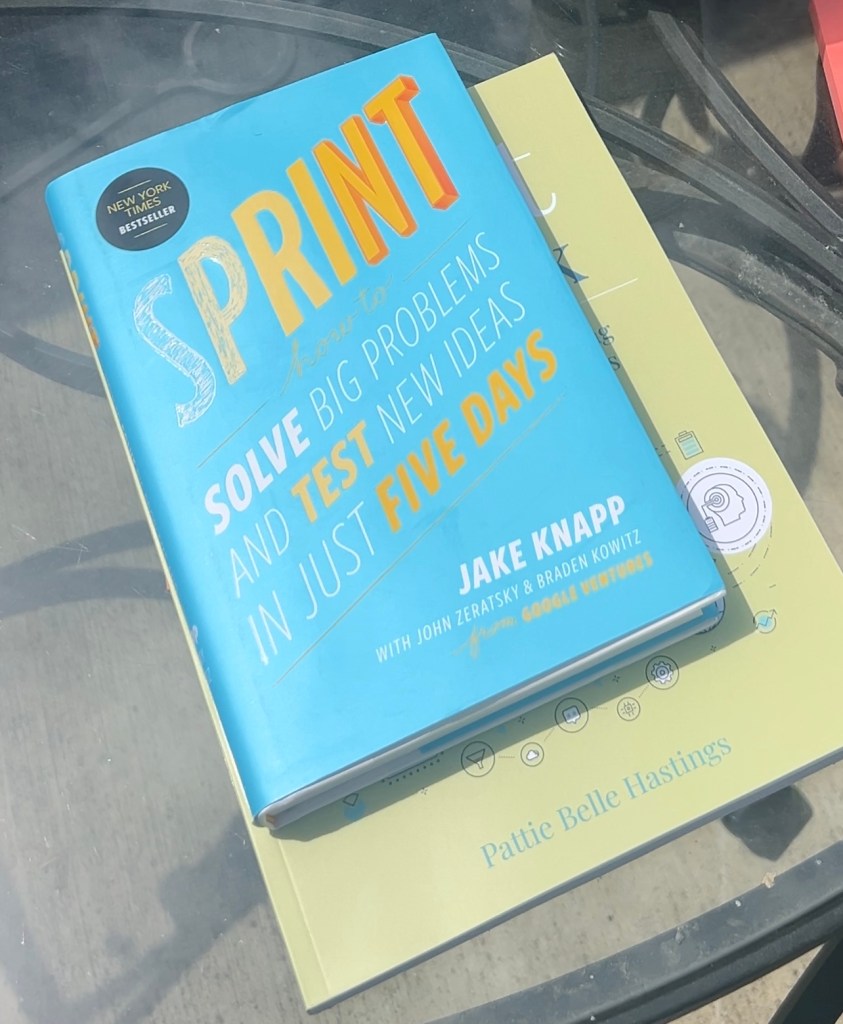
Design Sprints were invented by Jake Knapp, John Zeratsky, and Braden Kowitz in 2009. According to Knapp, “It’s a ‘greatest hits’ of business strategy, innovation, behavioral science, design and more-packaged into a step by step process that any team can use” (Knapp, pg.9). A Design Sprint is a five-day program with five phases to facilitate design thinking in a way to minimize risks and even failures when releasing a new product, service, or feature. The five phases in a Design Sprint consist of Mapping, Sketching, Deciding, Prototyping, and Testing. Each phase has its dedicated day, allowing for careful and thoughtful thinking at each phase of the program.
What would the Design Sprint schedule look like?
Monday: Mapping out the Problem
This is the first day of the program, where you answer the question of “How might we…” and you get to fill in the blank. It can be a problem as simple as making the website easier to maneuver or more intricate, like testing a start-up with its target public before taking the leap of faith and spending millions just to see the product fail in the real world. The point of Monday of the Mapping day is getting clear on what needs to be fixed, changed, or completely avoided. You may also want to ask the higher-ups at your company or organization for their thoughts on what the problems are or could be.
Tuesday: Sketching
This is probably the most creative day of the program. Tuesday, or the Sketching day, is reserved for ideating over possible solutions to the problem question we established on Monday. It is recommend to sketch individually as Wednesday will lead us in our next collaborative effort. The key to this day is not to compete with your peers for the best possible idea or most creative solution, but to just innovate.
Wednesday: Decide
On the third day, this is where we take all the individual sketches and decide which solution is the best INNOVATIVE solution to our “how might we…” question. This is where it’s imperative to have an impartial facilitator for your design sprint, as some people may feel very passionate about their sketch (which is great, but can actually do more harm than good in a time-constrained program like this).
Thursday: Prototype
What happens when we take Monday’s, Tuesday’s, and Wednesday’s work and combine them? We get to Thursday. Thursday is when we build out a prototype of the product, service, or feature that will be what our target public experiences on our fifth and final day of the program. The prototype can range from a brochure, a mock website, or a physical product. The point is to give the target public an experience of the solution to the problem.
Friday: Testing
Friday is the final step of the program. This is where you pull together a test group of your product, service, or feature’s target public. It can range from 3 people to 100 or more people. The importance of Friday is listening to the opinions and thoughts of your consumers. This will allow you to save time, money, and resources, as once you collect and reflect on all the responses to your product, you can go back to the drawing board and adjust accordingly.
Still confused about the stages and the concept of the Design Sprint? Watch the video below for extra context.
Sources:
“The Design Sprint.” The Sprint Book, www.thesprintbook.com/the-design-sprint. Accessed 22 May 2025.
Knapp, Jake, et al. Sprint: How to Solve Big Problems and Test New Ideas in Just Five Days. Simon & Schuster, 2016.
Varhatiuk, Kostia. “What’s a Design Sprint and Why Is It Important?” Fireart Studio, Fireart Studio, 13 Jan. 2025, https://fireart.studio/blog/whats-a-design-sprint-and-why-is-it-important/
 KOMA designs
Leave a comment